
This article reflects information as of 2020. For the latest details, please contact us.
The reality is that in any industry, you can't survive without constantly continuing to study. That's why, whenever a member of our team has a study session they want to attend, we back them all the way. We also value the reflection that comes afterward. We may not be making the most of it just yet, but I'm sure it will always help with individual growth and with the organization's productivity.
This is a rather belated study-session report, but since I wanted to write it up on our note, I'll share the two staff members' impressions and so on.
Staff Report 1
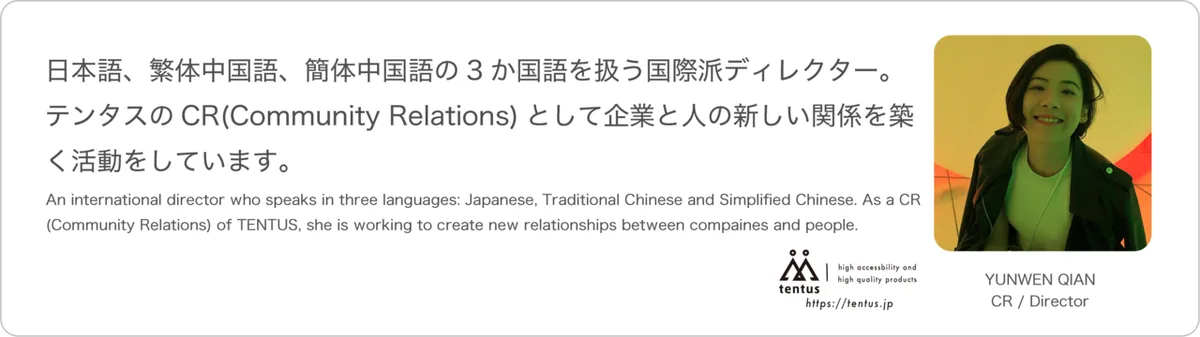
I attended a hands-on customer success study and consultation session hosted by a consulting firm called Creative Hope Inc. (hereafter CRH). Since CRH mainly supports EC consulting and customer success, the aim of the event was to introduce a B2C marketing tool called HubSpot.
Studying marketing terms (LTV, churn rate, upsell, cross-sell, and so on) was of course useful as new knowledge. As a consumer myself day to day, I realized how I get drawn in by sales techniques like upselling and cross-selling. The Google Analytics talk ran a full 40 minutes, but it was easy to follow. Analyzing data on each individual customer has almost nothing to do with our own business, but I really related to the idea that the times are always changing — where it used to end with reporting, now it starts with reporting. Apparently 65% of today's children will take jobs that don't exist yet, and somehow the change of the times is exciting.
And among the three presenters, I found myself thinking "hard to follow!", "clear and interesting!", and "clear but kind of boring." I want to be someone who's both clear and interesting to listen to! I really need to improve my Japanese…! That's all!
Staff 2 — Ashida, 25, director, from Chiba
Hands-on Customer Success Study & Consultation Session, 10/23, 16:00–19:00
Part 1: "About Customer Success (HubSpot sales)"
The importance of your existing customer base. As the 1:5 rule and the 5:25 rule show, acquiring new customers matters too, but retaining your existing base becomes crucial for growing revenue. What's important for customer retention is doing customer success. Customer success means "raising customer satisfaction and maximizing revenue by solving customers' problems and guiding them to success." Customers gain high satisfaction and continue and expand their use of the service. On top of that, it's a mechanism where referrals from customers bring in new customers. In customer success, "Customer Churn Rate" is often set as a KPI. New-customer acquisition and the like fall under sales and marketing, so they aren't set as KPIs here.
↓ From here, HubSpot sales. As stated above, customer success matters for satisfying customers and earning their trust, but the work of other teams matters too. "HubSpot" is a tool that lets the marketing, sales, and customer service teams cooperate with one another to nurture customers. HubSpot's customer-support model is the flywheel. It's a service that reduces friction and barriers between teams as much as possible and smoothly handles attracting (marketing), building trust (sales), and satisfying (customer success). The admin screens are apparently easy and intuitive for non-engineers to use too. Everyone, do give it a try.
Part 2: "Customer Analytics." Customer analytics is "a methodology for acquiring and using data from the customer's perspective to deliver a good customer experience based on understanding the customer." Old analytics reports had too many surface-level numbers — what sold, what times get the most access — and were too company-centric. Today it's an age where the customer is the star, and analytics from the customer's viewpoint are needed: from things like access increases/decreases and monthly sales, to changes in behavior and attitude, satisfaction, usability, hesitation, and so on. The purpose of customer analytics is "delivering highly relevant, desirable offers to customers in a timely way = providing a good customer experience." Concretely, you provide the customer experience (PR and marketing measures, etc.), measure it (integrating behavioral, psychological, and attribute data, etc.), and understand the customer (modeling the customer experience, etc.). And then the customer experience again — cycling through "Model," "Experience," and "Data." That's all. Please do use HubSpot.
Thank you for reading all the way to the end! We'll keep on writing going forward. We appreciate your support.