
This article reflects information as of 2020. For the latest details, please contact us.
Written by: Tomohiro Koizumi, Representative Director, tentus inc.
The futon cleaner: a new-category pioneer that suddenly appeared in the fiercely competitive home-appliance industry.
The first time you saw one, didn't you think, "Oh! Right, of course, I had been kind of bothered by that"?
Perhaps because many people feel a twinge of guilt that, while 60% of people wash the towel they dry off with after a bath every day, they don't really maintain the futon they sleep on every night — it became a big hit category, a rarity for the home-appliance industry in a while. (reference)
But since many people also think, "The old way was fine, so what's wrong with it?", one challenge for the manufacturer was reaching the "latent needs" segment who, at this point, don't feel it's necessary for them.
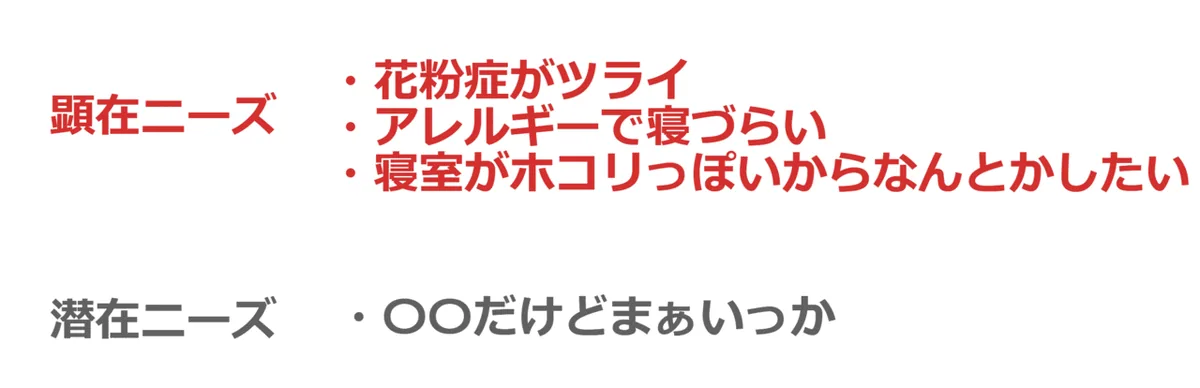
As shown above, for the "manifest" segment where some need has already arisen, you can follow up by appealing to the product's features and so on; but for the "latent" segment that doesn't feel the need in the first place, we struggled — neither image ads appealing to the benefits of using the product nor feature-focused ads appealing to the product's functions really resonated.
We tackled this challenge together with the client's marketing department.
We ran all sorts of measures — commercials, in-store units, and more — but throughout it all, the thing we put the most effort into was 【visualization】.
Visualizing the Hand Dryer
This "visualization" exerts an extremely strong effect, for better or worse.
Lately you've seen hand dryers in public restrooms and the like shut down across the board, right?
I think the first was a hand-dryer experiment done in 2014, where they put paint on their hands and used a hand dryer to see how much it scattered — and the resulting photos were pretty shocking.
https://www.thecut.com/2014/11/youll-never-want-to-use-a-hand-dryer-again.html
That gave hand dryers a "yikes, they're dangerous" image, and with the added infection risk of corona, most now seem to be out of use.
I don't think there's been much experimentation on whether infection really happens, and depending on the type of hand dryer some seem safe, but they've all been shut down uniformly.
Visualizing Running Droplets
In a similar case, you may have seen droplet simulations for running and cycling in the news and so on.
https://www.cyclesports.jp/news/others/21415/
This visualization gave, to some extent, an image of "runners are dangerous! breathing is dangerous! running is unforgivable!"
These are somewhat extreme examples, but by "visualizing" things that weren't visible before, you can appeal directly to people's emotions.
It's the old "seeing is believing."
The World of Close-ups Through a Microscope
One of the measures we did together with the futon-cleaner client was preparing, as a campaign giveaway, a microscope that connects to your phone.
Looking at your own futon with this microscope, you can visualize the skin flakes and dust-mite carcasses stuck between the fibers. (Live mites aren't really on the surface.)
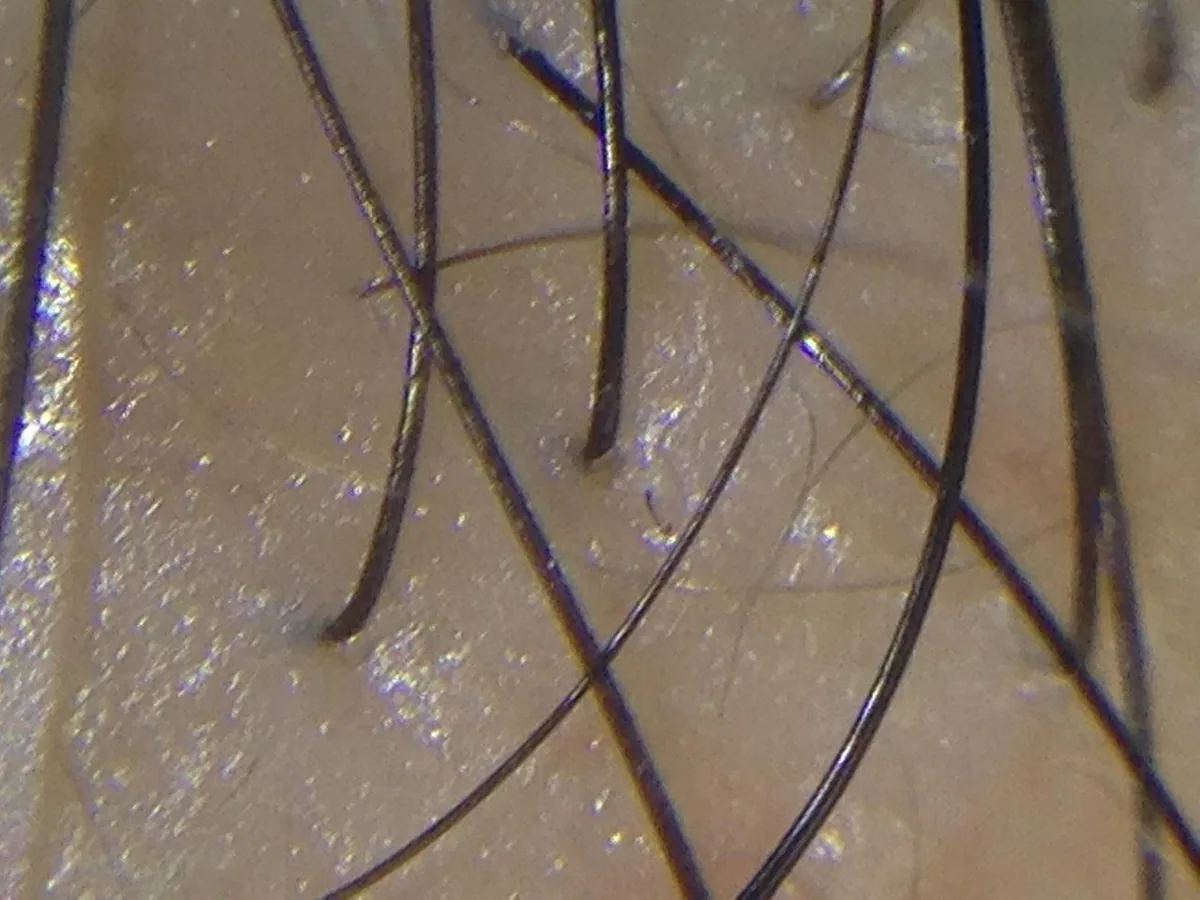
By the way, this is my own scalp, photographed with that microscope at the time. You could even see the clogged sebum.
Using a black light to visualize dust and such that isn't visible to the eye is apparently something companies like Duskin do too.
https://www.jyohoku.com/2016/09/09/1368/
In this way, by visualizing things you don't normally see, you can implant an image about something people weren't conscious of.
Visualization is a truly powerful tool, but the flip side is that even an unscientific approach "can end up looking convincing," a challenge that always follows it around — so you need to take the utmost care when visualizing.
There are many methods for surfacing latent needs, and the one introduced this time was a relatively impact-focused example.
There are various other methods besides this, so if surfacing latent needs is a challenge for you, please do get in touch.