
This article reflects information as of 2020. For the latest details, please contact us.
Web Tips
Web Tips: Avoiding the Pitfalls of Target Setting
2020.11.06
This article reflects information as of 2020. For the latest details, please contact us.
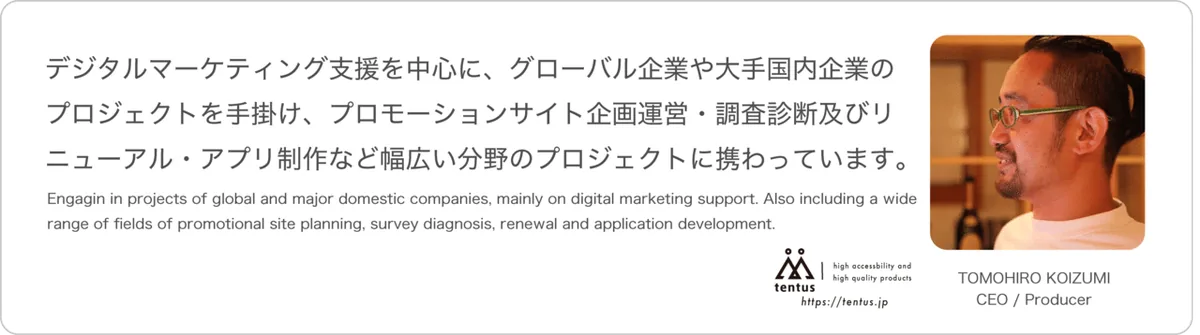
Written by: Tomohiro Koizumi, Representative Director, tentus inc.
Target setting is an unavoidable, important point in web production, but it's also a point that creates a great deal of confusion.
"Who is the target for your product?"
"Who is the target for this campaign?"
"Who is the target for next term's strategy?"
Conversations like this play out day and night, but a big pitfall is always lurking.
This time I'll introduce those pitfalls in two patterns.
I'll use a fictional frozen-gyoza (dumpling) maker as an example.
Pitfall 1: "Not narrowing enough"
"Who is the target for your frozen gyoza?"
"Our product doesn't have that strong a garlic taste, so it's easy for children to eat, and it's low in oil, so it's easy for the elderly to eat too. So the age range is roughly from the teens to the 80s, and it's for men and women alike."
"I see, I see." (That's basically the entire nation…)
This is an extreme example, but for many makers and products, dividing and targeting by age or gender in the first place is meaningless.
For products like razors or bras there's a necessity to divide by gender, but can you divide the various products currently in your field of view by age or gender?
In front of me are a laptop, a webcam, the mug I'm drinking coffee from, my mobile phone, and so on — but dividing these products by age or gender doesn't make much sense in itself.
It's common to set a main target for each product based on the thoughts and characteristics behind the product's development, but when it comes time to roll it out as a promotion, the word "main target" often gets replaced by the words 【the people we want to sell to】.
Well, if you're selling, there's no need to narrow attributes, so as a result you fall squarely into the pitfall of setting a target taken broadly, broadly.
This pitfall is big and deep, and its frequency of occurrence is also incredibly high.
I'll describe the solution later, but next is the second pitfall.
Pitfall 2: "Narrowing too much"
"Who is the target for your frozen gyoza?"
"Our product is modeled on Hamamatsu gyoza, so it's popular in the Shizuoka cultural sphere. We've designed it so that even busy homemakers can grill it easily, so it's appreciated more by dual-income households than by full-time homemakers, and it sells in supermarkets in the evening, so… our target is dual-income women living in Shizuoka who've come to the supermarket."
"I see, I see." (So! nar! row!)
Strictly speaking, this is the target segment producing the greatest effect, so limited to supermarket sales it's very good — but if you present this target when building a website, you'll have great difficulty because it doesn't fit the characteristics of the web at all.
This target is already a highly effective strategy within the client's business, so building a strategy that removes it is nonsense; but by fixating on it, you risk killing the merits the web offers.
In this way, when thinking about targets, problems arise whether you take them broadly or narrowly, and just how broad a target to take is a very difficult point to judge.
Advice for deciding targets
There are various theories on how to think about targets, depending on marketing books and the like, but what I often propose to clients is the following method:
"First, decide who to exclude."
If you think about the target you want to sell to, the target becomes broad; if you think about the most effective target, it becomes narrow.
So let's shift our thinking a little and decide first from 【the target we don't need to focus on】.
The simplest filter first excludes 【people who don't access that medium】.
For example, with a website, access from young children or the elderly isn't very efficient, so you put them into 【the target we don't need to focus on】. This is only natural if you think of it as the website's target rather than the product's target, but when you think centered on the product, exclusion becomes quite difficult.
Thinking with this logic, next — let's see — perhaps we could also exclude people who don't influence the purchasing behavior.
Within a married couple, it's often the man who ultimately purchases something like a family car, but there's an unseen family council beforehand.
For a high-involvement product like a car, you need to include people other than the actual purchaser in the target; but in the case of frozen gyoza on a website, perhaps we can exclude everyone other than the actual purchaser.
If it were a TV commercial that reaches people without them searching, it'd be a completely different story — and products like Cook Do aim to get everyone in the family eating together to say, in the commercial, "Ah, I want to eat green pepper and beef stir-fry tomorrow!"
And once you exclude this far, something comes into view.
"Wait — are the people who actually buy it even looking at the website before buying?"
Once you get here, you're almost at the goal.
That's right! People aren't buying frozen gyoza after looking at the website.
So in this project's case, you should set up media to build awareness in the first place, and for the website, use it as a catalog without thinking about targets.
This just happens to use frozen gyoza that sells in supermarkets as an example; it doesn't apply to all frozen gyoza.
For something with an angle like mail-order gourmet food, a need to set a web target would come up too, and even for similar products, all sorts of ways of thinking emerge.
This time was to convey the method of first trying to exclude rather than narrow the target — so please, once, pick up some product and practice excluding.
By excluding, the true target should come floating up.