
This article reflects information as of 2021. For the latest details, please contact us.
Written by: Tomohiro Koizumi, Representative Director, tentus inc.
Have you heard the term "cross-border EC"?
Have you ever bought some small item on Amazon or the like and had the package arrive from China?
That's cross-border EC from China's point of view.
It would be a real waste to run an EC site and yet keep your sales channels focused only on the domestic market, so this time I'll summarize cross-border EC.
Japan's EC market size
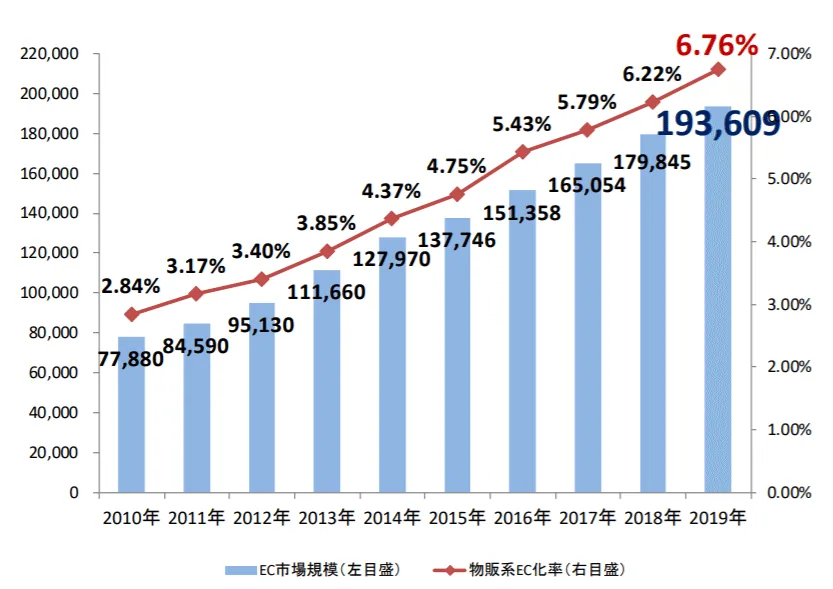
According to the Ministry of Economy, Trade and Industry / Survey on Electronic Commerce (FY Reiwa 1), the 2019 market size was 19.3609 trillion yen, with an EC ratio of 6.76%.
When the amount is large it's hard to tell whether that's impressive or not, but considering that Japan's domestic restaurant industry is 26 trillion yen (Statistical materials, market-size data, transition of restaurant-industry market size — Food Safety and Reliability Foundation), I think it's fair to say the EC market size is quite large.
The world's EC market size
Now let's turn our eyes to the world's EC ratio and market size.
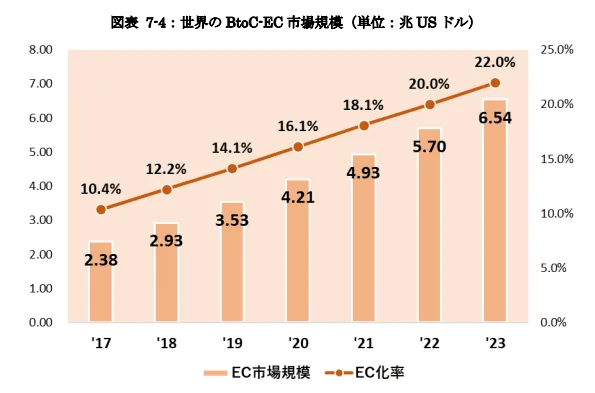
According to the Ministry of Economy, Trade and Industry / Survey on Electronic Commerce (FY Reiwa 1), the 2020 EC ratio was 16.1%, and the market size was 4.21 trillion USD—440 trillion yen in Japanese yen, an enormous market size.
Notably, within the world's 440-trillion-yen market size, China's market size alone reaches 253 trillion yen—meaning more than half of the world's EC sales are consumed by China alone. Astonishingly, in 2018 data, just three countries—Japan (4%), China (52%), and the US (18%)—accounted for over 70% of the world's EC market.
Cross-border EC market size
So what about the market size of cross-border EC, the focus this time?
According to the Ministry of Economy, Trade and Industry's "FY2018 Infrastructure Development for a Data-Driven Society in Japan" (2019), the 2020 forecast is 99.4 trillion yen, so cross-border EC is predicted to be about one quarter of the overall EC market size.
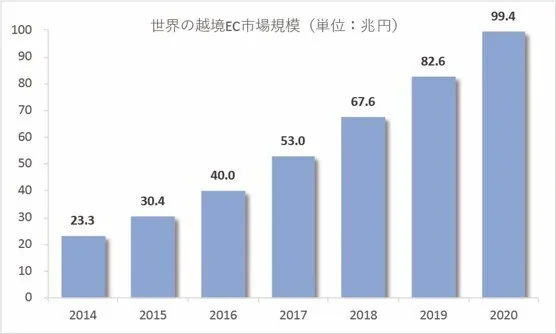
In this way, thanks to the development of distribution networks and the like, cross-border EC sales are predicted to keep growing significantly.
What are the best-selling products in cross-border EC?
From the data so far, I think you've gotten a sense of the scale merits of doing cross-border EC.
However, the products favored in cross-border EC differ greatly by country.
The "TOP 5 products selling worldwide shipped from Japan," compiled by "BEENOS Cross-Border EC World Hit Ranking 2020," are:
■ US popular TOP 5
- Toys, games
- Fashion
- Music
- Cars, motorcycles
- Comics, anime goods
■ East Asia popular TOP 5
- Toys, games
- Fashion
- Antiques, collections
- Home appliances, AV, cameras
- Music
■ Southeast Asia popular TOP 5
- Toys, games
- Fashion
- Cars, motorcycles
- Accessories, watches
- Sports, leisure
■ Europe popular TOP 5
- Toys, games
- Music
- Fashion
- Cars, motorcycles
- Home appliances, AV, cameras
Toys and games are #1 in every country, but #2 and below are all over the place.
Looking further in detail by country, the sales rankings differ greatly by country, and just comparing the rankings of China, Korea, and Taiwan, the best-sellers are truly all over the place, with plenty of products that make you go "why on earth is that selling?"
For this reason, when starting cross-border EC, "what products to sell targeting which country?" becomes the most important point to consider.
Things you absolutely must be careful about to start cross-border EC
So let me summarize four points to be careful about when actually starting cross-border EC.
-
Is that product okay to send to that country? For example, Australia has very strict inspection of food, making it one of the countries where mail-ordering food is very difficult. Each country's pharmaceutical laws and such are important too. Some products are legal in one country but illegal in another, so confirming whether the product you intend to sell is okay to sell in that country is a very important point.
-
What about shipping costs? Shipping methods? Distribution differs greatly by country. Shipping costs and methods in particular are reflected in the price, so it's very important to calculate in advance what method you'll ship by and roughly how much it will cost.
-
What about personal information protection laws? Handling of personal information also differs greatly by country. Japan has the Act on the Protection of Personal Information, but Europe has the GDPR, one of the strictest laws in the world. The GDPR became famous for imposing very large penalty fines on companies that don't handle personal information appropriately, but the US, China, and others also have their own rules, so you need to be careful about handling personal information when doing cross-border EC.
-
Are the religious rules okay? This is especially important in Islamic regions—using product images that expose women's skin may be NG, and products using religiously NG ingredients and such can develop into major trouble.
There are various other points to consider besides these, but the point is that you need to know the target country and culture.
Putting it this way makes cross-border EC look a bit high-hurdle, but these are points you can avoid if you know about them.
In closing
We currently offer services like the following. Not only the cross-border EC I wrote about this time, but also if you want to do EC domestically, or you're a bit curious but don't know what to do—if you have even a little interest, please feel free to contact us!